What is a cozy farming sim?
A cozy farming sim is built on one unit of play: the day. You wake to more jobs than will fit, spend daylight and energy choosing between them, and go to bed. Nothing can be lost: the design effort goes into making a routine worth repeating, rather than into anything you could fail.
Morning: the list
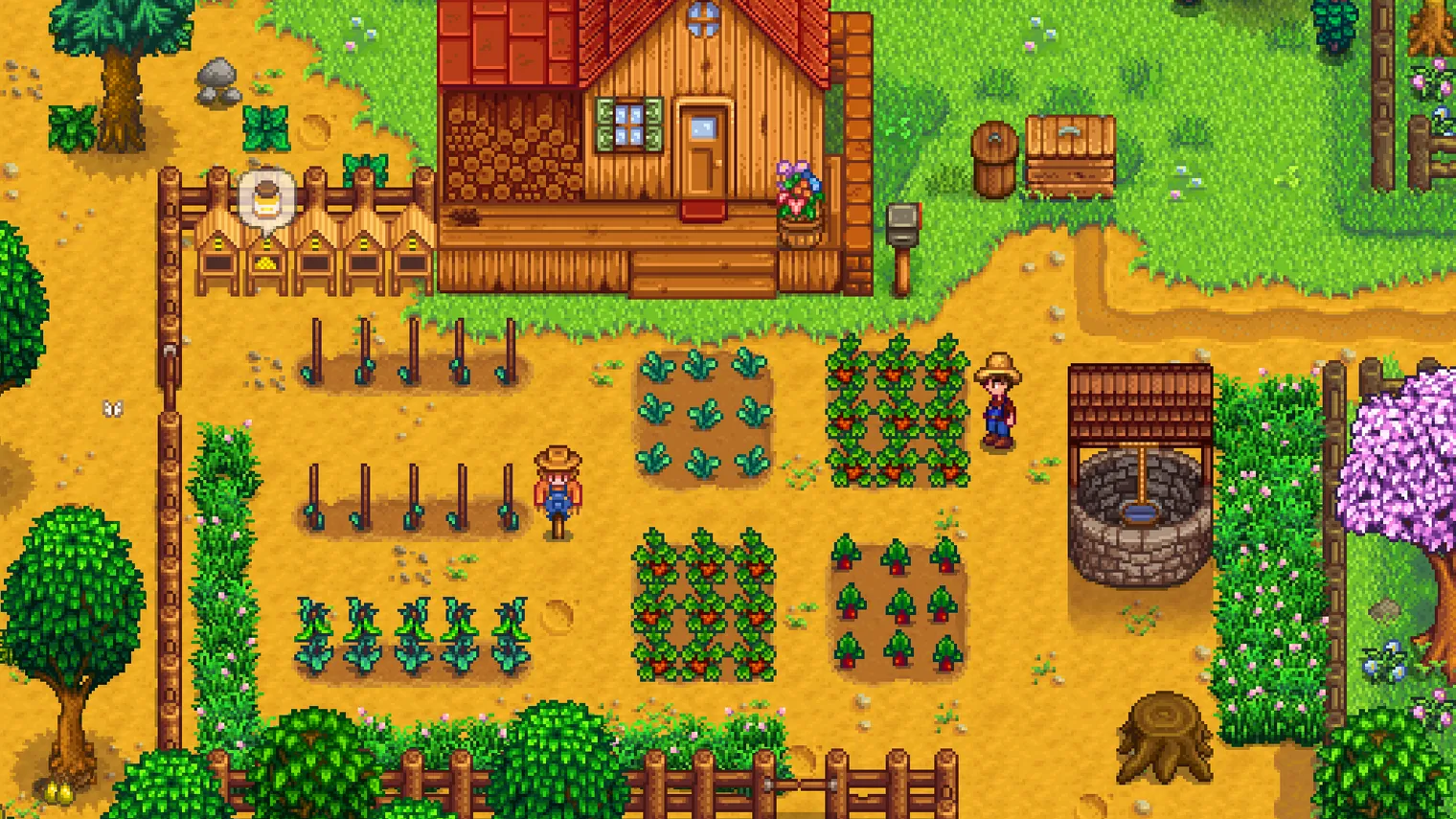
The farm presents itself as chores. Water the rows, feed the animals, clear a little more land, see what the shop has in. Harvest Moon made the radical move of treating that list as the entire game, on consoles otherwise busy with jumping and shooting: no villain, no combat, and a courtship system whose boldest mechanic was remembering what somebody liked.
One thing worth knowing before you buy anything with that name on the box: Marvelous and Natsume parted ways in 2014. The original series continued as Story of Seasons; Natsume kept the Harvest Moon title for games of its own. The lineage everyone means when they credit Harvest Moon now sells under the other name, and the shelf can send you home with the wrong series.
Afternoon: the town
Chores done, the rest of the day is people: a gift, a conversation, a festival circled on the calendar. Relationships open story rather than stats, and they live or die on the writing. Villagers who are gift-dispensers with a heart meter make a town feel like a vending machine; villagers with routines, grudges and off days make it feel inhabited, and there is no boss fight here to hide thin writing behind.
Animal Crossing supplies the other pole: no farm at all, a village wired to the real-world clock, shops that shut in the evening and seasons that turn when yours do. Its insight, that a game can politely wait for you, is half of what cozy came to mean. The farm itself is swappable: a café, an inn or a village shop slots into the same day, and My Time at Portia points the loop at crafting commissions without changing anything structural. Rune Factory goes the other way and puts a dungeon under the farm, at which point the calendar is from here and the combat is borrowed from action RPGs.
Evening: the shipping bin
The day closes with a tally. You drop the harvest in the bin, it sells overnight, and the morning opens with money for better tools, more land or another animal. Progress compounds sideways rather than upward: better tools shorten the chores, new land extends them, artisan goods thicken the economy, and none of it makes you stronger in any sense a combat game would recognise.
Sleep: the only hard stop
Energy and daylight are the whole pressure system, and they push in one direction only: never you might lose, only you can't do everything today. Stay out past your limit and you collapse, and the game charges a little money and a slow morning rather than anything you would call a punishment. Sleep is also the save, which means stopping feels sanctioned rather than stolen, and why one more day is this genre's one more run.
The soft scarcity that makes year two worth wanting
You cannot grow every crop, court every villager and clear every stone in year one, and that is deliberate. Seasons rotate the crops and the events, so a plant missed in spring waits for next spring: about as close to consequence as the genre allows itself, and the reason a second year is something you want rather than something you tolerate.
The calibration is fine-grained. Remove that scarcity and the game goes slack; sharpen it and you have built a farming roguelike with pastel lighting. The colony sim is the useful contrast (the same daily stewardship with catastrophe switched back on, tending as crisis management instead of comfort) and when the relationship half outgrows the farm entirely, what is left is a visual novel with the watering can set down.
When cozy is just a colour palette
Cozy is a storefront sticker now, applied to anything with pastels and a soft font. The chores have to feel like something (the thunk of an axe, the darkened soil behind the watering can, the little jingle when a crop comes up) because the daily loop is the whole game, and without that feedback farming is a menu with a sound effect. Thin chores and a handful of lines per neighbour show immediately in a genre this quiet.
Then there is the genre's own embarrassment. Even the great ones turn a good share of their players into optimisers, planning perfect seasons with a wiki open on a second screen. The games about slowing down are unusually good at producing people who refuse to.
The brief, gentleness included
Gentleness is easy to assert and hard to specify, so the brief has to carry the structure underneath it:
Type:        Cozy farming sim (a life sim with no fail state; the crops are optional)
Core loop:   Spend a finite day on chores, neighbours and the shipping bin, then sleep
Perspective: Top-down or 2.5D, warm and legible at a glance
Win / lose:  Neither; the only pressure is that the day ends before the list does
Session:     One in-game day at a time, ended by a save you never have to make
Progression: Tools, land, artisan goods and relationships, paced by the season
Then decide what your player is short of: daylight, energy, or how many people they can be kind to before dark. That shortage is the only pressure this genre permits, and everything gentle about it is built on top of it.