What is a roguelite?
Every roguelite asks one question, and the answer sets the rest of the design: when you die, what survives? The procedural map, the drafted upgrades, the run that ends in forty minutes; those are common to the whole family. The carry-over is what separates one of these games from the next.
The dial
Slide left and the game is a test. Slide right and it becomes a campaign wearing a run's clothes. Neither end is wrong, but they want different players and they fail in opposite ways.
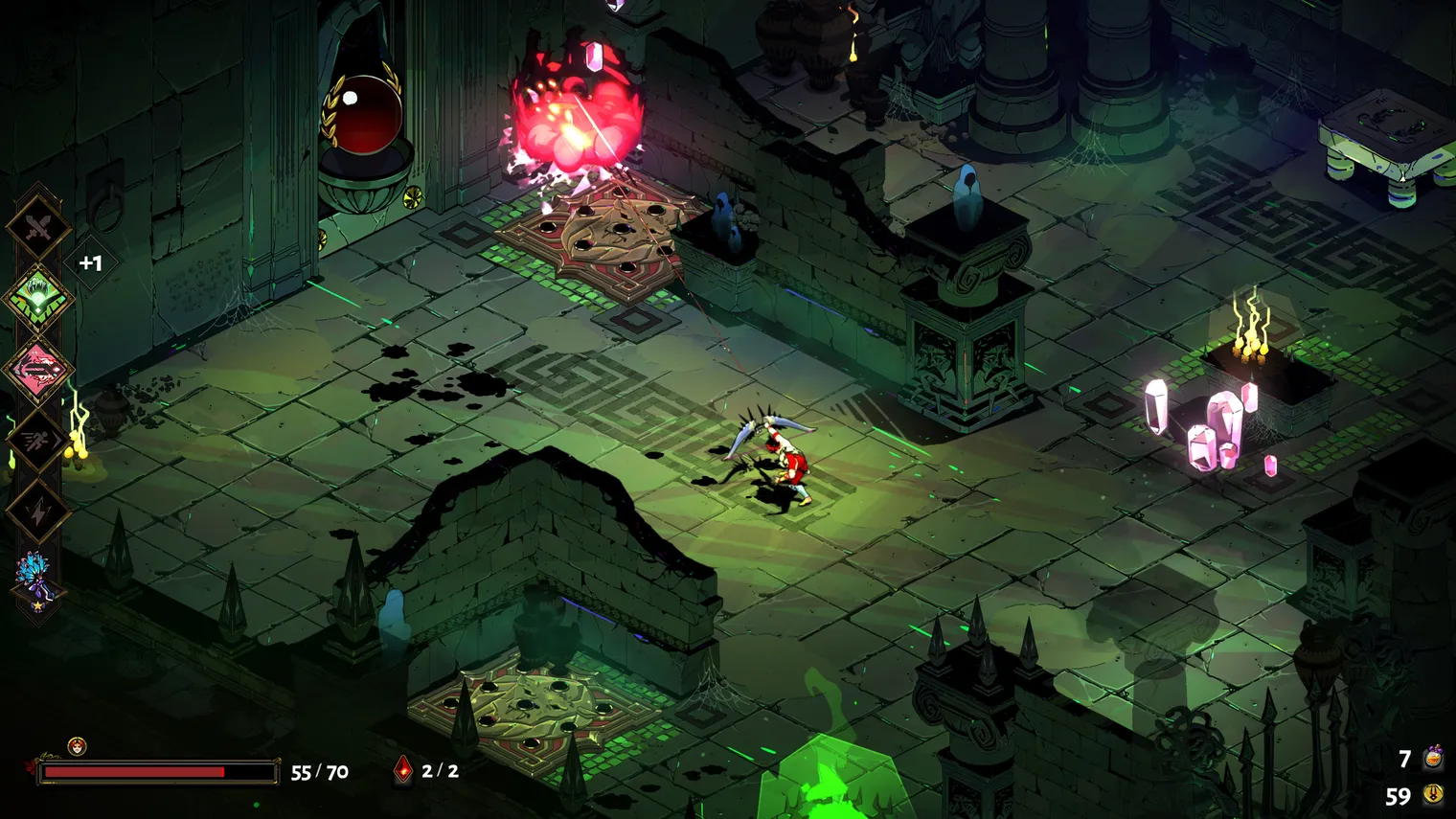
Roguelike or roguelite?
The argument is older than either word. Rogue was a terminal dungeon crawler that generated a new dungeon every time and deleted your character when you died, and the games built in its image kept that creed for decades. In 2008 a group of developers met in Berlin and wrote the definition down: the Berlin Interpretation, a list of factors including random environments, permadeath, turn-based movement on a grid and resource management. It was meant as a description. It has been used as a border ever since.
The useful test is shorter than the list. Ask what dying costs. If the answer is "everything except what I now know", you are holding a roguelike. If the game hands you a currency on the way out, it is a roguelite. Spelunky is the instructive case: full permadeath, almost nothing banked beyond shortcuts, though Spelunky 2 will store a few items at Waddler's for your next attempt. That is the whole spectrum arriving inside one series.
What the dial costs you
Too far right and the early hours are scripted losses. When permanent upgrades carry the difficulty curve, your first runs are balanced around numbers you don't have yet, and a death traces back to arithmetic rather than to a mistake you can name. Practice quietly becomes a queue. The tell is a player who isn't improving and is winning anyway.
Too far left and the wall never moves. With nothing banked, the only thing that improves is you, which is exactly the appeal until it isn't, and the audience that bounces off is much larger than the audience that stays.
The good ones spend their meta-progression on options rather than percentages: a new weapon in the pool, a route you couldn't take before, a modifier that changes the questions a run asks. One makes the next run different. The other just makes it shorter.
There is a second axis worth setting on purpose, because it decides whether a run is worth finishing: how much your rewards collide. Procedural generation is cheap; procedural situations are not. If two mediocre pickups can combine into something absurd, every run is a fresh negotiation. If each reward's value can be read off its own text, the generator is decoration and every run converges on the same build by the halfway mark.
The structure travels well beyond action games, which is why the shelf around it is crowded: deckbuilders pour the whole loop into cards, and survivors-likes keep the runs and the drafting while deleting the aim button.
Where your game sits
The dial belongs on the first line of the brief, not in a footnote:
Type:        Roguelite (meta-progression between runs; a roguelike keeps none)
Core loop:   Fresh procedural run, drafted upgrades, push until you die
Perspective: Any, since the run structure is the genre, not the camera
Win / lose:  Win by clearing a full run; death ends it and banks the currency
Session:     20-45 min for action roguelites; an hour or more for card-shaped ones
Progression: Temporary build inside a run; permanent unlocks between them
Set the carry-over deliberately and the rest of the design has something to argue with. Leave it unset and you get the default: a competent run-based game that nobody finishes twice.