What is tower defense?
Tower defense is the strategy genre where you never fight. Enemies walk a route towards something you care about, you place towers beside that route, and the towers do all the shooting. What you manage is money, and the money comes from the enemies, which is the arrangement everything else hangs off.
The exchange
Every enemy that dies pays you a bounty. That bounty buys the tower that kills the next wave, which pays for the one after, so the economy is the difficulty curve: fall behind by one wave's income and you are permanently a wave behind. Lives run the other way and never refill. There is no recovery mechanic, only a slower loss.
That makes spending an argument with itself. A tower placed now earns kills for the rest of the map, so early money compounds, but the expensive towers change what is possible, and saving three waves for one of them can be the better trade. Good tower defense hands you the information to make that call: a preview of the next wave's composition, and the freedom to study the map before anything moves. Difficulty should then arrive as mixture rather than as bigger health bars, because layered questions force layered answers and the same wave with more hit points is only a tax on your time.
Four jobs, four counters
Towers divide into four roles, and each one has something it answers and something that answers it.
| Tower job | What it's for | Beats | Beaten by |
|---|---|---|---|
| Single-target | Concentrated damage, one enemy at a time | Armoured elites and bosses | A crowd; it kills one thing while the rest walk past |
| Splash | Damage across everything in a radius | Dense waves, and enemies that split when they die | A single tough target, and enemies strung out down the path |
| Slow | Holds enemies inside everyone else's range | Runners; it multiplies every damage tower near it | Bosses that resist it, and alone, it kills nothing at all |
| Support | Range, damage or income for its neighbours | Nothing directly; it raises the ceiling of what surrounds it | Being bought early, when a plain damage tower would have held |
Enemies are designed to punish the gaps between those four. Armoured ones shrug off light fire, runners outpace your slows, flyers ignore the path entirely, and camouflaged ones stay invisible until a tower grants detection. A mixed wave is a question, and your layout is an answer you committed to three waves ago.
Upgrades are where the roles get expensive. Bloons TD gives each monkey three upgrade paths and lets you take exactly one of them to tier five and a second no further than tier two (the 5-2-0 rule) so choosing a tower is really choosing which two of its three futures to abandon.
Path or field?
One structural choice changes everything else. On a fixed path the route is drawn for you and the game is about coverage: which corners see the most road, which straight flatters a sniper, where a slow buys the most extra seconds. On an open field there is no path until your towers make one, and the towers are the walls: placement becomes maze-building, and a single badly placed block can shorten the route you spent the whole map lengthening.
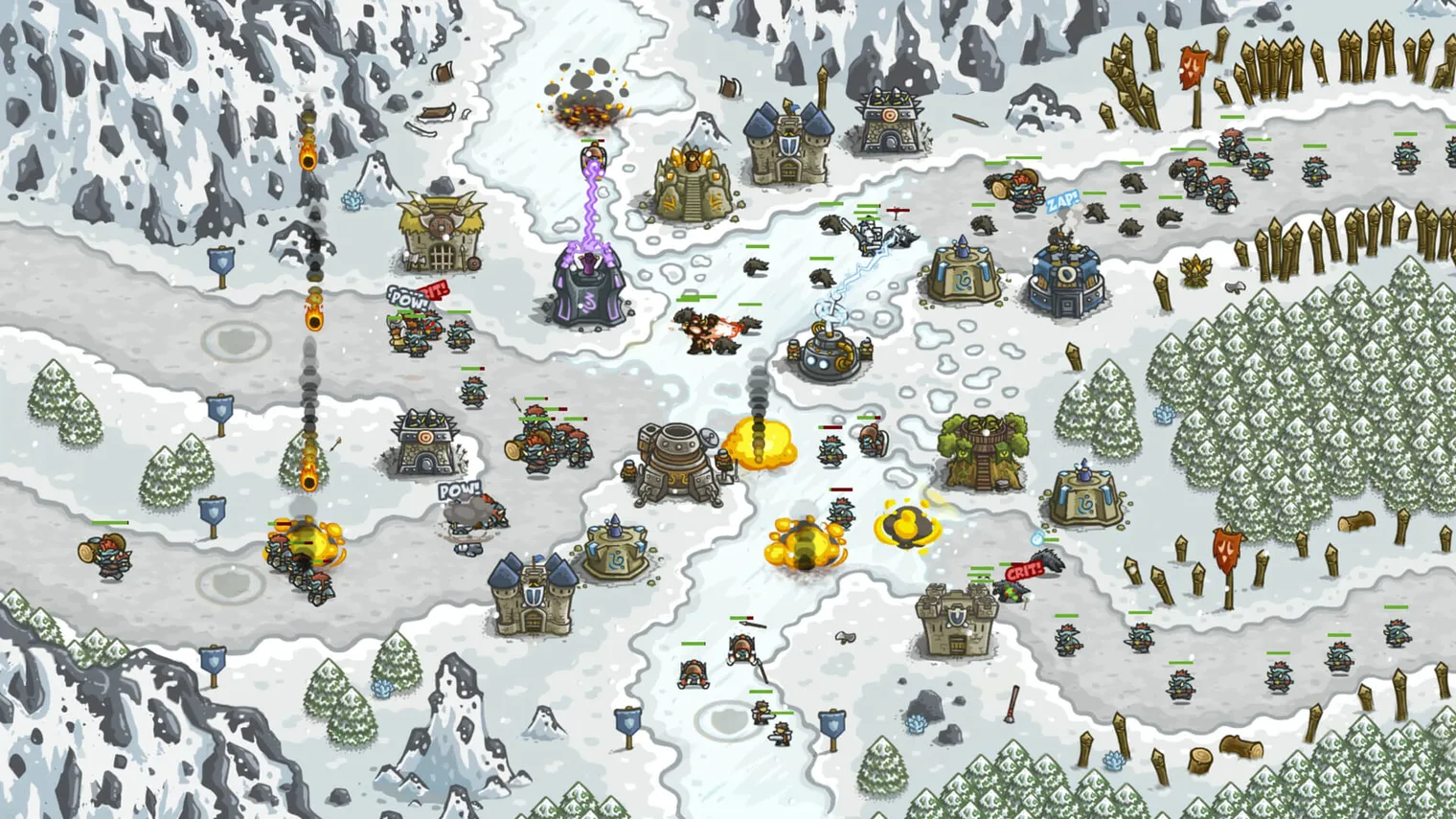
Both branches were worked out in public. Rampart, Atari's 1990 arcade game, had you raising walls and siting cannons between bombardments: the field, before anyone drew a path. The habits that made a genre came out of the WarCraft III and StarCraft custom-map scene, where modders kept the base-defending part of a real-time strategy game, deleted the rest, and shipped both branches at once: lane maps that hand you a route, maze maps that hand you an empty field. The browser era spread them (Desktop Tower Defense codified the open field) and touch screens then made tap-to-place the most natural gesture a finger has. Kingdom Rush shows what a fixed path buys in exchange for the freedom: barracks that put soldiers on the road, holding enemies inside your towers' range until placement becomes choreography. Plants vs. Zombies splits the difference into lanes, each row of the lawn its own small front.
The spectator problem
The genre's honest flaw is inseparable from its appeal. The pleasure is building a machine that works without you, so the moment it truly works, you are a spectator at your own game. Late waves on a won map are a screensaver. Endless modes outlive their interesting decisions. A curve made of health multipliers cannot ask a question your maze has not already answered.
Everything designers do about it puts your hands back in: heroes you steer, spells on cooldown, targeting priorities worth switching mid-wave, towers that need feeding. Orcs Must Die! takes it furthest by dropping you into the corridor as the last tower with legs. The nearest genre by feel is the auto-battler (arrange the machine, then watch it argue with someone else's) while the survivors-like is this loop turned inside out, with the auto-firing tower walking around as you. Take the enemies away entirely and the placement-and-economy pleasure is a city builder.
Specify the gauntlet
Type:        Tower defense (fixed path, or open field where your towers are the walls)
Core loop:   Read the coming wave, spend the bounty the last one paid, place and upgrade, hold
Perspective: Top-down or isometric over one fixed map
Win / lose:  Survive every wave; lose when a life pool that never refills empties
Session:     A map in 10-20 minutes; endless modes run past their last real decision
Progression: Tower unlocks and upgrade trees carry between maps
The best moment in a tower defense and the worst one are the same moment: the machine running without you. Every design decision in the genre is an argument about how long to let that last.