On Saturday afternoon I downloaded Unreal Engine for the first time in my life. I had never opened it, never placed an actor, never written a Blueprint. I knew it was the engine with the very good-looking demos and a reputation for being a lot.
On Sunday evening, at about 19:46, I submitted a game made in it to the 2026 Epic AI MegaJam. The deadline was an hour and thirteen minutes later, which is the closest I have ever come to a sensible margin and still felt like a near miss.
It's called Before the moon sets, and I'm aware that "beginner makes 3D action game in a weekend" is a sentence that should make you suspicious. It made me suspicious too. So here is how it actually happened, including the part where I did very little of the typing.
What it is
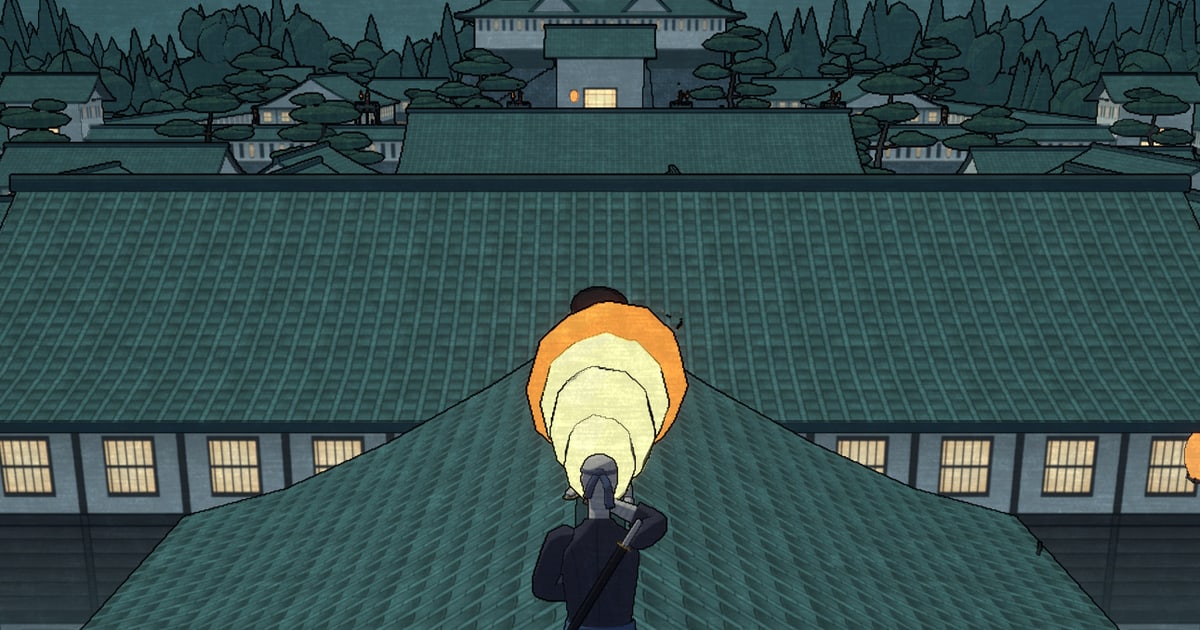
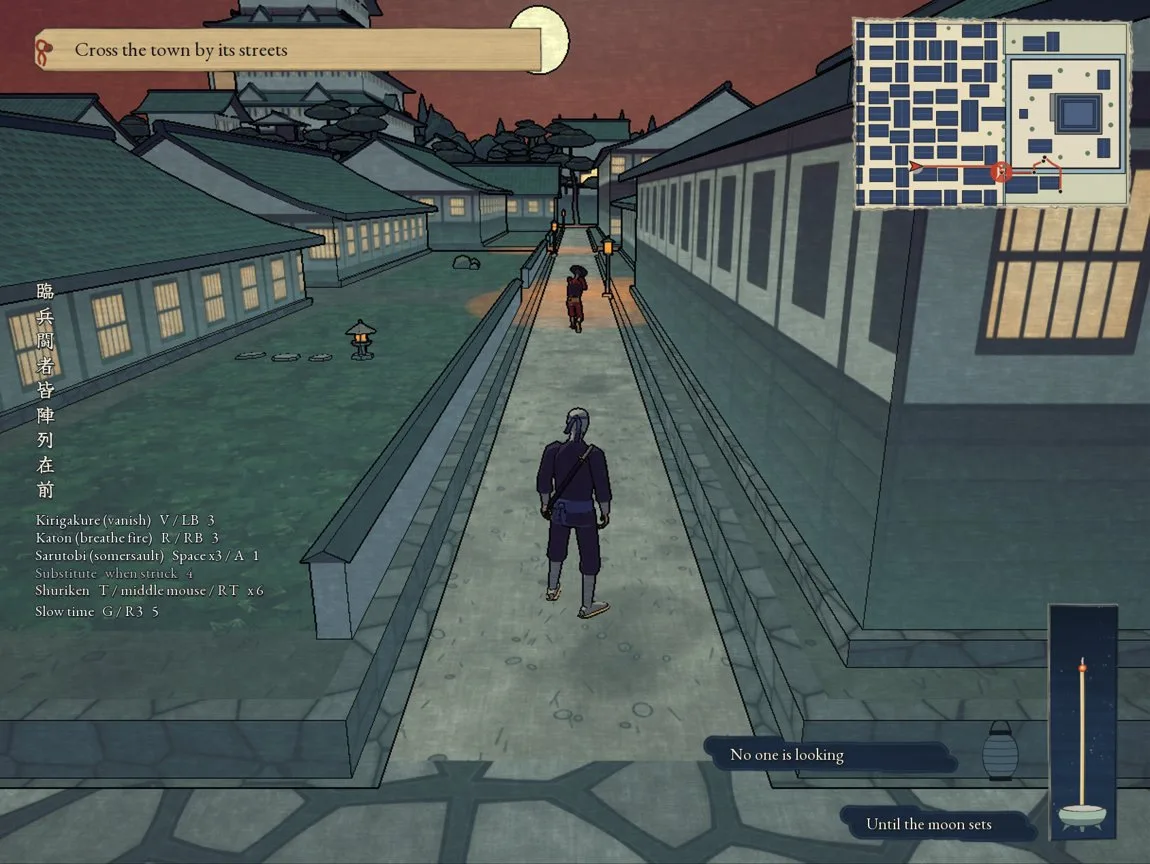
Iga, 1578. A lord is raising a castle in the middle of the valley and nobody in Iga asked for it. You're Ariake, an eighteen-year-old ninja who is good on a roof. The whole thing is drawn like a Japanese woodblock print: flat bands of colour, an ink key line, Prussian-blue night for the first mission and a red dusk for the second, paper grain over everything.
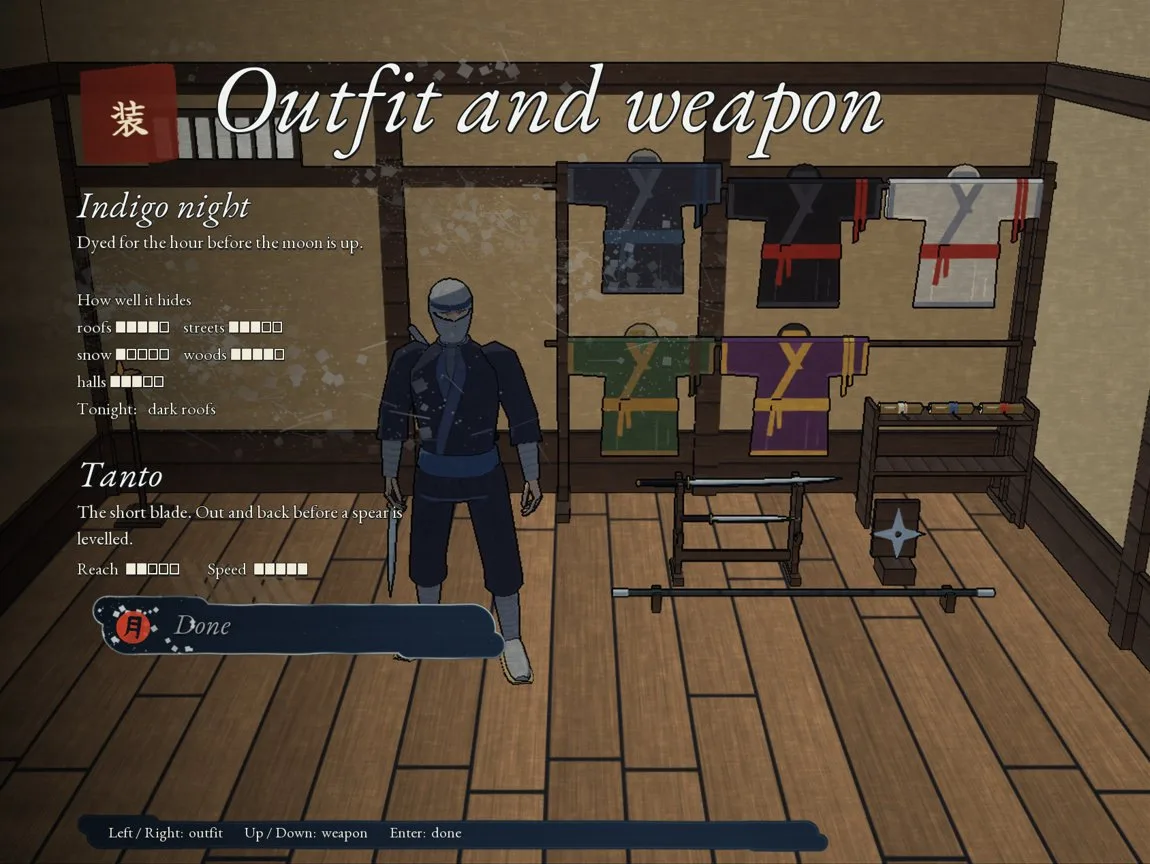
The first mission is a run across the town's roofs past spearmen and archers with fire arrows, then up the keep and through three floors of halls to the lord of the castle. The second is played by stealth, at dusk, at street level, between the watchmen's lanterns. There are five outfits and four weapons, and the outfit matters: a white jacket in a lit street gets you seen almost at once.
It's Windows only, it's a jam build, and the itch.io page says "in development", which is true in the most literal sense available.
The weekend, roughly
The jam's theme was Director's Cut, which turned out to describe the process better than the game. I directed. The hands were Claude, working through Claude Code: one main session and, over the two days, eight helper sessions with a part each (among them the keep, its defenders, the fighting moves, the stealth mission, sound, story, the itch.io page), up to six of them at once, all driving the same Unreal Editor through its MCP server.
Nothing in it was modelled, painted or recorded by hand. Every building and prop is geometry written out by a Python script. Every texture is painted by a script. Every sound, from footsteps on tile to the alarm drum and the music, is synthesised by a script with no samples. Every Blueprint graph is written by a script that talks to the editor. (The characters do use Unreal's mannequin skeleton and its stock animations. I'm stubborn, not deranged.) By Sunday evening that was about 60 Python files and 26,000 lines, in 30 commits.
That isn't purity. A script can be read, fixed and run again by a session that has never seen the asset. When the ninja's neck looked wrong, the fix was a line in a generator, not a mesh nudged by eye at two in the morning by someone who'd installed the editor the day before.
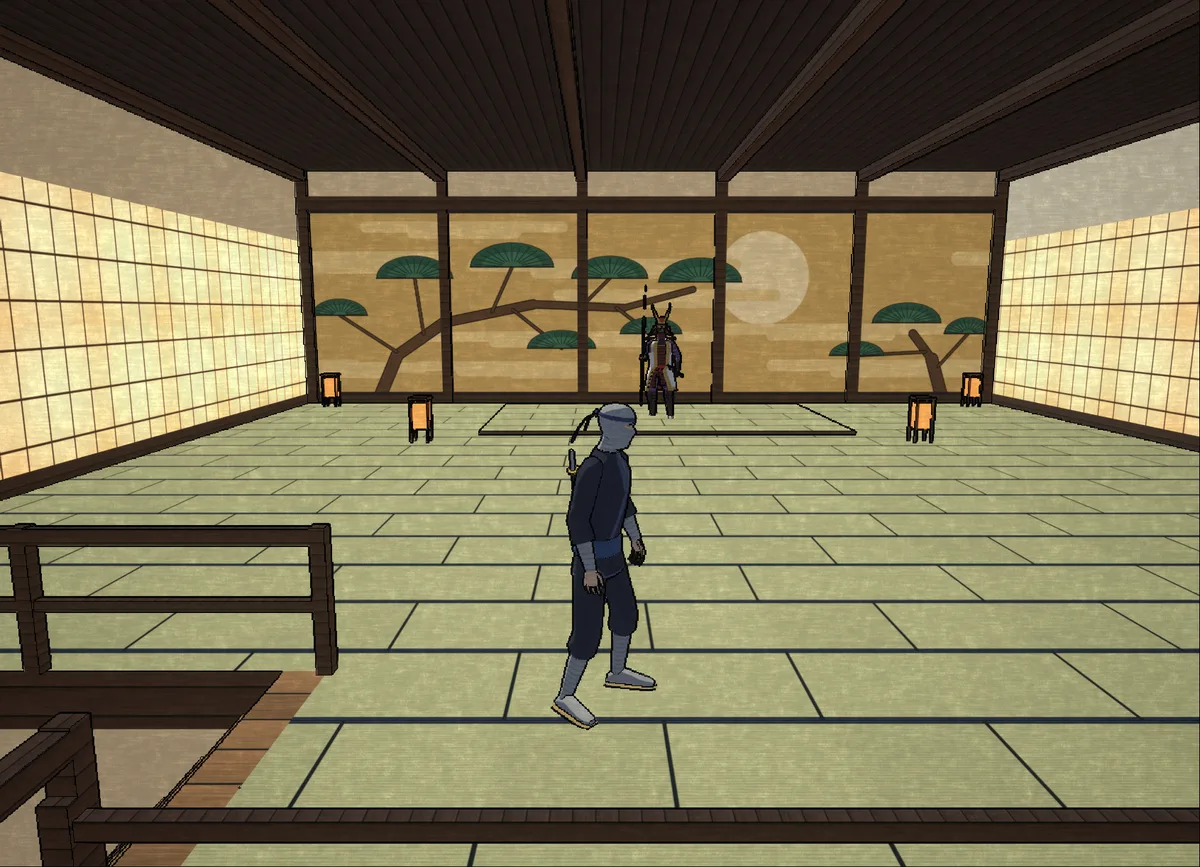
My part was the calls, and most of them were cuts. No flat cut-outs. No buildings that overlap from above. Gardens with "irregular flat stones as a proper zen garden", and no stairs that end at a wall without a door. Early on Sunday afternoon: no more scope, finish what's in flight so I can play it. Then the session preparing the jam page read the rules and found that submissions closed in seven and a half hours and needed a packaged build and a video, and the plan, which still had four or five hours of interface polish in it, was cut the same hour.
Four builds, three plays
Every part had a scripted test that held keys down in a running game and read the numbers back. On the final build a script won the first mission, roof to lord, in 87 seconds. None of which means anything, because a script doesn't play a game. It completes one.
So I played the packaged builds. The first ended with me typing "This is not the build". The second got "much better" and a list: keep the camera behind the ninja, add a map, make enemies actually fall over, offer the second mission when you win the first. The third found that the stealth mission didn't end anywhere you could see, that you could walk round the moat on dry land, and that the roofs were a free pass past the watch. Each list was built, tested and packaged again inside an hour or two. The fourth package is the one on itch.io.
Every one of those plays found something no script had. Worth remembering the next time a test suite tells me a game is fine.
The one useful thing: a lock for the shared editor
The hard part wasn't Unreal. It was nine conversations and one editor. Two sessions pressing Play at once, or one rewriting a Blueprint while another places actors, wreck each other's work, and nothing in the editor stops them.
What stopped them was a rules file every session reads first, plus a queue for the editor itself. Any session that wants to play the game, or make a change that takes more than a few seconds, takes the lock first and gives it back after:
# every session, every time it touches the shared editor
python SourceArt/build/editor_lock.py wait-idle            # until nobody is mid-Play
python SourceArt/build/editor_lock.py acquire moves 7200   # join the queue, wait up to 2 h
#   ...play, test, rewrite a graph: everything in one short turn...
python SourceArt/build/editor_lock.py release moves
It's handed out in the order it was asked for, and a lock nobody renews for 25 minutes counts as abandoned. With five sessions in the queue a turn could take twenty minutes to come round, so they learned to ask early and do everything at once. Anyone running more than one agent on anything that only exists once (an editor, a simulator, a phone) wants this before the second agent starts, not after.
The rules file earned its keep the hard way. One Blueprint that didn't compile made the editor ask "are you sure you want to Play?" in a modal window nobody was looking at, and five sessions queued behind it for two hours. That went into the rules the same hour, along with a small watcher that closes the dialog. The file reads like a list of every way I lost an afternoon, which is exactly what it is.
What it doesn't prove
It doesn't make me an Unreal developer. I can now tell you what a Blueprint is, which is more than I could on Friday, but I didn't write one; I described them. Nobody has tried it with a gamepad. Some garden walls in the second mission have no collision, so you can walk straight through them. And in the interest of the honest scoreboard: I played the final build for about five minutes, recording the video, not through both missions.
What it does prove, to me at least, is that "I don't know this engine" has stopped being the reason not to try something. The bottleneck was never the typing. It was knowing what I wanted and saying no to everything else, quickly. That part was still mine, and it's still the only part I'd claim.
The jam version stays frozen on its page, as the jam asks, and there's a longer dev log there with the full timetable. Go and run some roofs.
More soon: RSS if you'd like to see what I learn to do badly next weekend.