If you land on a game studio's website, you see the games. Reasonable: the games are the point. But at 0n1 the games are only about half of what actually gets built, and for a long time the other half never left my machine. So I gave it a page of its own. It's called Workshop, and it's where the tools live.
What's on it
Workshop lists three things: twelve tools, six games, and this website. The games you may already know: LineBy is out; the other five are still wearing "coming soon." The tools are the part most people never see. They're the studio's own AI toolchain: software I built to build everything else. One generates the art (Forge). One posts the daily puzzle to Instagram (Herald). One runs the App Store releases (Odin). One remembers what I've learned so I don't have to relearn it next month. The page's own one-liner says it best: each exists because a game needed it.
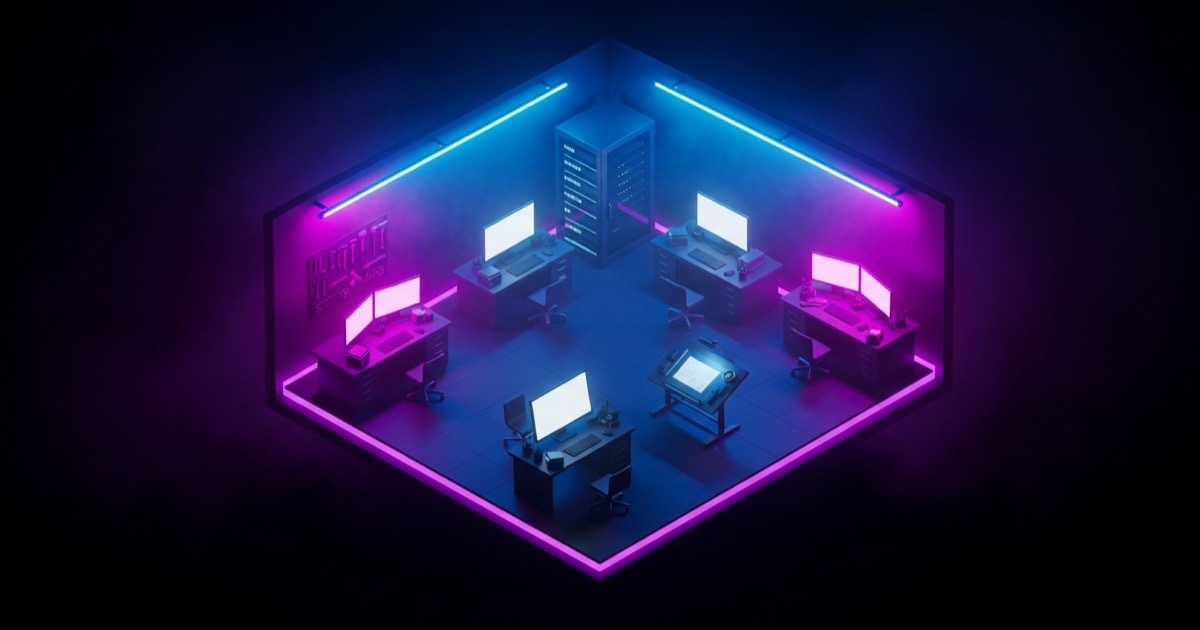
And they're not a dull list of repositories. The toolchain renders as a little isometric office, one desk per tool, and every tool is a character you can click to ask what they do. It began as a joke about my "team" and became the most honest thing on the site: for a studio this size, the tools are the team. I don't have a marketing department: I have Herald. I don't have an art department: I have Forge.
Why put the tools on display
Because they're the actual story. Anyone can ship a game. The question I'd want answered if I were reading someone else's build-in-public is the harder one: how does one person keep six games and a website moving without the wheels falling off? The answer isn't heroics or late nights. It's the toolchain. Hiding it would mean hiding the part that makes the rest possible.
There's a second reason, and it's the one I care about more: it keeps me honest. Every card shows that tool's real commit activity over the last eight weeks: not a trophy number, just how busy that corner has genuinely been. A tool that's gone quiet says "quiet lately" rather than pretending. And the whole page is rebuilt on every deploy, so it can't slowly drift into fiction: if the work stops, the bars go flat, in public.
What Workshop is not
It's not a store. You can't download any of these tools and there's nothing here to buy: they're internal, built for one studio, and they stay that way. The charts are commit counts only; the code stays private until it ships inside a game. Workshop is a window into the workshop, not a shelf in it. I wanted you to see the machine, not sell you a piece of it.
That's the same deal the games run on: no ads, no tracking, no dark patterns, and no claims I can't back up. (That last rule is a practice, not a setting: I try to hold to it, and every so often I have to enforce it on myself, after the fact.) Workshop just extends it to the half of the studio you'd normally never get to see.
So, go meet the team. Click a teammate and they'll tell you what they build. It's the closest thing I've got to an office, and unlike a real one, the lights being on actually means something.
More soon: RSS if you'd like to follow along.