Ask an AI to "make me a game" and it will. Instantly, confidently, and completely on its own terms. It has to fill in the blanks you left, and it will, with the most statistically average game it can imagine. You'll get a top-down thing with a score counter and a jump button, and you'll stare at it thinking that's not it, without being able to say what it was.
The problem isn't the model. The problem is that you handed it a mood and expected a genre.
The type is the first decision, not a label you add later
I've written before about how an idea isn't a game until you write the mechanics down. The genre (the type) is the very first of those mechanics, and it's load-bearing in a way that sneaks up on you. "Roguelite" isn't a tag you slap on at the end. It's a decision that already answers a dozen questions you haven't asked yet: runs are short, death resets you, the map is generated, power is temporary but progress isn't. Say "roguelite" and all of that arrives for free, for you and for the model.
That's the leverage. One well-chosen word carries a whole ruleset of shared assumptions. Skip it, and every one of those assumptions gets guessed instead.
Reminder #1: Before the loop, before the pitch, pick the type.
Same idea, two types, two different games
Say your mood is "a game about running a coffee shop." Watch what the type does to it:
- Tycoon / management sim → top-down, you set prices and hire baristas, the sim runs the crowd, there's no fail state, the fun is the growing numbers.
- Cozy sim → first-person-ish, you pull the shots yourself, regulars have names and stories, the seasons turn, the fun is the routine.
Same three words of inspiration. Two completely different builds: different camera, different loop, different win condition, different feeling. If you don't name which one, the AI picks for you, and it's a coin flip whether it's the one you were daydreaming about.
Reminder #2: The type decides the camera, the loop, and the fail state. Choose on purpose.
A type is a template with five blanks
Here's the part that makes this practical. Every genre is really a little brief with the same five blanks, and once you can fill them in, you've written something an AI can actually build from:
Type:        <e.g. roguelite deckbuilder>
Core loop:   <what the player repeats, second to second>
Perspective: <top-down / side-on / first-person / text…>
Win / lose:  <how a run ends, both ways>
Session:     <how long one sitting is>
Progression: <what carries forward, if anything>
Pick a type and four of those blanks fill themselves in from convention. Your job shrinks to the interesting part: where your game breaks from the template. "A cozy sim, but the town is slowly flooding." "A tower defense, but you play the monsters." The type gives the AI the 90% that's shared so you can spend your words on the 10% that's yours.
Reminder #3: Describe the genre's defaults, then the one twist that's yours.
So I built a map of the types
Naming a type only works if you know the types. So I made a reference for it (not a spreadsheet, but a place you can actually fly through): the Game Atlas.
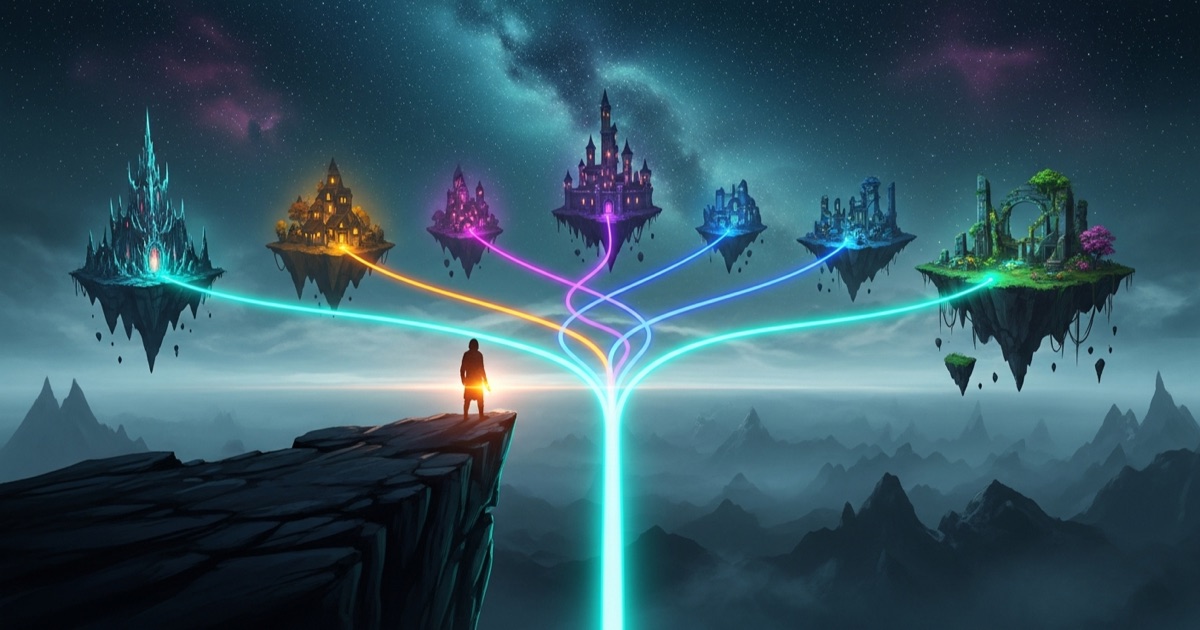
It's a 3D world of the big genres (point-and-shoot, roguelite, metroidvania, deckbuilder, tower defense, cozy sim, visual novel, and more), grouped into families you navigate by. Click any one and you get its definition, a few games that nail it, and those five blanks pre-filled, ready to copy into your GDD and hand to your AI. It's the field guide I wish I'd had the first time I typed "make me a game" and got somebody else's.
And it's step one of something bigger: soon you'll be able to paste a link to your own game and watch the Atlas place it, showing which type it lands nearest, and which ones it's quietly borrowing from.
Name the game first. Everything after that gets easier, and you stop building the average of every game and start building yours.
Go wander the Atlas, then write the file. RSS if you want to follow along.